
Who Was Ruth in the Bible? The Moabite Widow Who Walked Into the Line of Jesus
A foreign widow, a desperate mother-in-law, a quiet redeemer, and a baby born at the end whose great-grandson would be David.
- Era
- The days of the Judges, roughly 1100 BC, between Joshua and the monarchy
- Role
- Moabite widow, daughter-in-law of Naomi, wife of Boaz, great-grandmother of David
- Key book
- Ruth, four chapters, between Judges and 1 Samuel
- Famous line
- Where you go I will go, and where you stay I will stay (Ruth 1:16)
By Daniel Reeves · Editor, The Bible Well
Published
The book of Ruth is four chapters long. You can read it in twenty minutes on a quiet evening, and when you finish you will know almost every name that matters in it by heart. Naomi the bitter, Ruth the Moabite, Boaz the kind, Obed the baby. But the book is not really about any of those four people. It is about the way God's covenant with Israel turns out to have a back door, and a foreign-born widow walks through it, and the line that runs out the other side ends at a manger in Bethlehem a thousand years later. This page covers who Ruth was, what she actually did, why a Moabite woman ends up in the family tree of Jesus, and what Boaz of Bethlehem has to do with the gospel.
Where to find Ruth in the Bible
The book of Ruth sits between Judges and 1 Samuel in the Christian Old Testament, four chapters in a single short scroll. In Jewish Bibles it is grouped with the Megillot, the five short books read at festivals, and Ruth is read each year at Shavuot. The timing matters: the very first line tells you the story takes place "in the days when the judges ruled," roughly 1100 BC, when Israel had no king and the book of Judges has just finished cataloging what happens to a people when everyone does what is right in their own eyes.
If you have never read Ruth before, sit down with chapters 1 through 4 in one go. The whole book is shorter than a long magazine article. It is one of only two books in the Bible named for a woman, the other being Esther.
The world Ruth walked into
The book opens with a famine in Bethlehem. The name Bethlehem means "house of bread," and the irony is the point: the house of bread has no bread. A man named Elimelech, his wife Naomi, and their two sons Mahlon and Kilion leave their hometown and cross the Jordan into the country of Moab, looking for food.
Moab was not a neutral place for an Israelite family to go. The Moabites were descendants of Lot, by the older of his two daughters, and the people Balak had hired Balaam to curse Israel from in Numbers 22. Deuteronomy 23:3 had said no Ammonite or Moabite could enter the assembly of the Lord. And yet here is an Israelite family settling in among them, and within a few verses the two sons have married Moabite women named Orpah and Ruth.
Then everything falls apart. Elimelech dies. The two sons die. Naomi is left in a foreign country with two foreign daughters-in-law, no husband, no sons, and no grandchildren. In a culture where a woman's safety and survival ran through the men of her household, she has nothing.
Naomi loses everything (Ruth 1)
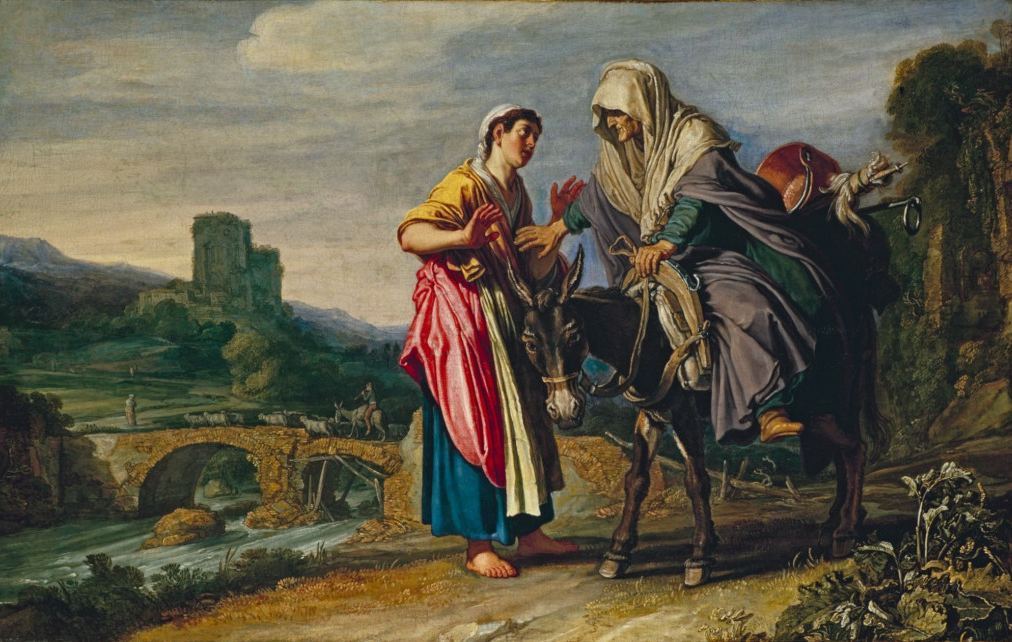
There is a sentence in Ruth 1 that the church reads past too quickly. Naomi hears in Moab that the Lord has come to the aid of his people in Bethlehem and given them food again. So she sets out for home with her two daughters-in-law walking with her. And then, on the road, she stops, and tells them to go back.
She is not being cold. She is being honest. She has nothing left to offer them. There are no more sons in her body. There is no future for two young Moabite widows attached to a bitter old Israelite woman walking back to a town that probably will not welcome them either. Orpah, after a long argument, finally kisses Naomi goodbye and turns back. Ruth does not.
But Ruth replied, "Don't urge me to leave you or to turn back from you. Where you go I will go, and where you stay I will stay. Your people will be my people and your God my God. Where you die I will die, and there I will be buried. May the Lord deal with me, be it ever so severely, if even death separates you and me."
— Ruth 1:16-17
This is the vow people quote at weddings, and it is misread there. Ruth is not speaking to a husband. She is speaking to her dead husband's mother, a woman with nothing, on the side of a road in the middle of nowhere. The vow is to the older woman. The God she is choosing is the God of a household that has lost almost everyone. There is no upside in it for her. She is choosing it anyway.
Naomi stops arguing. They walk to Bethlehem together, and when they arrive the whole town stirs and asks, "Can this be Naomi?" The narrator's note is hard to read in any translation:
"Don't call me Naomi," she told them. "Call me Mara, because the Almighty has made my life very bitter. I went away full, but the Lord has brought me back empty. Why call me Naomi? The Lord has afflicted me; the Almighty has brought misfortune upon me."
— Ruth 1:20-21
Naomi means "pleasant." Mara means "bitter." She has come home empty, and she names herself accordingly. The first chapter ends with a line so quiet you almost miss it: it was the beginning of the barley harvest.
The gleaning field (Ruth 2)
The second chapter opens with a man named Boaz, a relative of Naomi's late husband Elimelech, "a man of standing." Ruth, with no other way to feed herself or Naomi, goes out to glean. The law in Leviticus 19 and Deuteronomy 24 gave the poor, the foreigner, the widow, and the orphan the right to follow behind the harvesters and pick up what was dropped. It was the Old Testament's last line of defense against destitution.
Ruth happens to glean, the text says, in the field belonging to Boaz. The Hebrew narrator winks at the word "happens" the way a person winks when they don't believe in coincidence. Boaz comes out to his field, sees a woman he doesn't recognize, asks who she is, and is told, "She is the Moabite who came back from Moab with Naomi." He goes to her directly.
He does three things in three sentences. He tells her not to glean in any other field. He tells her she will be safe with his workers. And he tells her she can drink from the water his men have drawn. Then he says one of the most quietly beautiful lines in the book:
"May the Lord repay you for what you have done. May you be richly rewarded by the Lord, the God of Israel, under whose wings you have come to take refuge."
— Ruth 2:12
She has been in Bethlehem long enough to be a known person. The God she chose on the road back from Moab, the God of the empty mother-in-law and the unwelcoming town, is the God whose wings she has come under. Boaz sees it. He goes further: at the meal he hands her roasted grain himself, and he quietly tells his workers to pull out extra stalks from the bundles and leave them on the ground for her to find.
She comes home with about an ephah of barley, roughly twenty pounds, an absurd amount for a gleaner to bring home in a day. Naomi looks at it and asks where she has been. When Ruth says the name Boaz, Naomi sits up.
"The Lord bless him!" Naomi said to her daughter-in-law. "He has not stopped showing his kindness to the living and the dead. She added, 'That man is our close relative; he is one of our guardian-redeemers.'"
— Ruth 2:20
A guardian-redeemer, in Hebrew go'el, was a near male relative with the legal right and the family obligation to step in when one of his kin had lost everything. He could buy back a sold inheritance, ransom a relative from slavery, marry a widow to keep her dead husband's name alive. Naomi has just realized that the man in whose field her daughter-in-law has been gleaning is one of those relatives. The empty woman who came back from Moab has just glimpsed a door she did not know was there.
The threshing floor (Ruth 3)
The third chapter is the part of the book modern readers find strange and ancient readers found brave. Naomi tells Ruth to wash, put on perfume, dress in her best clothes, go down to the threshing floor where Boaz is winnowing barley, wait until he has eaten and lain down to sleep, then quietly uncover his feet and lie down at the foot of his bed.
Read in a thousand-year-old culture, the move is not seduction. It is a legal claim, deliberately made at night so that if Boaz refuses no one's reputation is destroyed. Ruth does exactly what Naomi tells her. In the middle of the night, Boaz wakes, startled to find a woman lying at his feet, and asks who she is.
"Who are you?" he asked. "I am your servant Ruth," she said. "Spread the corner of your garment over me, since you are a guardian-redeemer of our family."
— Ruth 3:9
She is asking him to marry her. The Hebrew phrase "spread the corner of your garment" is the same gesture Boaz used in chapter 2 when he prayed she would be sheltered under God's wings. She has just taken Boaz's own blessing and handed it back to him as a marriage proposal. He understands her immediately. He calls it a kindness greater than the one she showed earlier, and tells her there is one problem: there is a nearer relative with the first right of redemption. He will go to the city gate at dawn and find out whether that man will pay the price or step aside.
She sleeps at his feet until before dawn, leaves before anyone can see, and walks home with another six measures of barley he has pressed into her shawl. Naomi sees them and says simply, "Wait, my daughter, until you find out what happens. For the man will not rest until the matter is settled today."
The city gate (Ruth 4)
The fourth chapter is the most legally formal in the book. Boaz goes to the city gate, the public square where business and law were transacted, and waits for the nearer relative to walk by. He calls him over, sits him down in front of ten of the town's elders, and lays out the case. Naomi is selling the field that belonged to Elimelech. The nearer relative has first right of refusal.
The man says he will buy it. Then Boaz adds the part the man didn't know was attached. The field comes with Ruth the Moabite, the widow of Mahlon, and the obligation to marry her and raise up a son to carry on her dead husband's name and inheritance. The man backs out immediately. He cannot endanger his own estate. He pulls off his sandal in the formal gesture of releasing his claim, and tells Boaz the redemption is his.
Boaz turns to the assembled elders and says he is taking Ruth as his wife. The whole town blesses the marriage. They mention Rachel and Leah, the matriarchs who built the house of Israel, and Perez son of Tamar, whose own birth was a redemption story. The marriage is sealed. And then the line that hits hardest:
So Boaz took Ruth and she became his wife. When he made love to her, the Lord enabled her to conceive, and she gave birth to a son.
The Moabite widow with no future at the start of chapter 1 has a baby in her arms by the end of chapter 4. And the women of the town do not bring the baby to Ruth. They bring him to Naomi.
The women said to Naomi: "Praise be to the Lord, who this day has not left you without a guardian-redeemer. May he become famous throughout Israel! He will renew your life and sustain you in your old age. For your daughter-in-law, who loves you and who is better to you than seven sons, has given him birth."
— Ruth 4:14-15
The woman who walked into Bethlehem calling herself Mara is holding a grandson. The text says she takes him and lays him on her lap and becomes his nurse. The empty woman is not empty anymore. The book ends with a one-line genealogy that turns the whole story inside out.
The women living there said, "Naomi has a son!" And they named him Obed. He was the father of Jesse, the father of David.
— Ruth 4:17
The Moabite gleaner and the kinsman-redeemer of Bethlehem are the great-grandparents of King David. The book you thought you were reading about a sweet old story of loyalty turns out to be a hinge in the history of Israel.
Timeline of key events
- Famine in Bethlehem. Elimelech, Naomi, Mahlon, and Kilion leave for Moab (Ruth 1:1-2)
- Mahlon marries Ruth, and Kilion marries Orpah (Ruth 1:4)
- Elimelech dies, and ten years later both sons die (Ruth 1:3-5)
- Naomi sets out for home. Orpah turns back, Ruth refuses (Ruth 1:6-18)
- Naomi and Ruth arrive in Bethlehem at the start of barley harvest (Ruth 1:19-22)
- Ruth gleans in the field of Boaz (Ruth 2)
- Naomi sends Ruth to the threshing floor, where Ruth asks for redemption (Ruth 3)
- Boaz settles the matter at the city gate and marries Ruth (Ruth 4:1-13)
- Obed is born, and the genealogy ends at David (Ruth 4:14-22)
Ruth in the line of David and Jesus
A thousand years after the events of the book, Matthew opens the New Testament with a genealogy. It begins with Abraham, runs through David, and ends at Jesus. Matthew, a Jewish writer working in the first century, includes four women by name in the family tree of the Messiah, which is itself unusual for a Hebrew genealogy. One of them is Ruth.
Salmon the father of Boaz, whose mother was Rahab, Boaz the father of Obed, whose mother was Ruth, Obed the father of Jesse.
— Matthew 1:5
A Moabite woman, a foreigner from a people Deuteronomy had told Israel to keep out of the assembly of the Lord, is named without apology in the line that runs to Christ. Iain Duguid, who wrote a full-length commentary on Ruth, calls the book a quiet argument that God's grace has always been bigger than ethnic Israel and that the family tree of the Savior was always going to include the outsider. Ruth is not the only foreigner in Matthew 1, but she is the most deliberately named: "whose mother was Ruth" sits in the genealogy like a hinge.
The Bible Project's video on Ruth puts it well: the book is the story of a hidden God. The name of the Lord is on the lips of the characters constantly, but the Lord himself does not appear, does not speak, does not perform a single miracle in the narrative. He works the entire story through the choices of two widows and one good man, until at the end you look up and realize the kingdom you didn't know was being built has just been laid out in front of you.
How Boaz points to Jesus
Boaz is the clearest type of Christ in the Old Testament outside of Joseph. The pattern is exact in three places.
First, Boaz is the willing redeemer. The nearer relative had the first legal right but he would not pay the cost. Boaz could have stood by, because the law did not require him to step in over the head of a nearer kinsman. He volunteered. The whole transaction at the city gate turns on the moment Boaz declares, in front of the elders, that he will pay the price the other man refused. Christ is the willing redeemer of his people. He did not have to come. He came.
Second, Boaz redeems a foreigner. Ruth had no claim of birth on the covenant of Israel. She was a Moabite, an outsider, with no inheritance in the land. Boaz brings her in by marriage. He covers her not because she earned it but because she came under his wings. The shape of what he does is the shape of what Christ does for Gentile believers, brought into the family of God not by blood but by being covered.
Third, Boaz redeems at cost. The reason the nearer relative backed out is that the redemption would have damaged his own estate. Boaz absorbed that cost. The pattern points forward to a redeemer who pays a price his people could not pay, on a hill outside Jerusalem, also not far from Bethlehem.
Tim Keller, in his preaching on Ruth, presses one more line through the pattern: a redeemer has to be near kin. Christ became flesh, became one of us, became a near kinsman to humanity, so that he could be in a position to redeem us at all. Boaz could not have redeemed Ruth from across the road. He had to be family. The incarnation is what makes the cross legally possible.
Lessons from Ruth's life
- Loyalty written into a vow outlasts the moment that produced it. Ruth made her promise to Naomi on a road in the middle of nowhere with nothing to gain. She kept it through hunger, gleaning, and a marriage to a man she had not yet met. The vow held.
- God works in the ordinary. No angel appears in the book of Ruth. No miracle happens. No prophet speaks. The Lord runs the entire story through famine, migration, a gleaning law, a kind farmer, and a baby's birth. If you are waiting for a parting of the sea before you call something God's hand, you may miss most of what God is doing.
- Bitterness is not the last word. Naomi names herself Mara in chapter 1 and the women of Bethlehem call her Naomi again by chapter 4. The book does not rebuke her grief. It just refuses to let it have the final say.
- Foreigners are not afterthoughts in the kingdom. A Moabite widow ends up in the genealogy of the Messiah. The grace that ran through Israel was always headed for the nations.
- A redeemer is not optional. The whole book turns on the moment Boaz pays the price. Ruth cannot save herself, Naomi cannot save herself, and the nearer relative will not. Without a willing redeemer, the family line ends. The shape of that need is the shape of the gospel.
Related questions
+What is Ruth famous for in the Bible?
+What kind of woman was Ruth?
+What was Ruth's famous verse?
+Why is Ruth so special?
+How does Boaz point to Jesus?
Further study
Iain Duguid's Ruth: The Pattern of Reverence (P&R, 2016) is the most accessible full-length evangelical commentary, written warmly and tight to the text. Dale Ralph Davis on Ruth, brief and pastoral, is what most evangelical pastors reach for first. If you want the wider canvas, the BibleProject overview of Ruth traces the book's themes in eight minutes and pairs well with sitting down to read the four chapters straight through. The Joseph story in the life of Joseph is the closest Old Testament parallel for the way God's hidden hand runs the whole plot, and Abraham's call is the covenant beginning that Ruth's story turns out to be the back door into. For the line that runs from Ruth's baby to Bethlehem's most famous king, read the story of David next.
Related questions
+What is Ruth famous for in the Bible?
Ruth is famous for three things, in this order. The vow she made to Naomi in Ruth 1:16-17, where she chose her grieving mother-in-law's people and God over her own. Her marriage to Boaz, the kinsman-redeemer who covered her family's debt and brought a foreign widow into the household of Israel. And her place in the genealogy of Jesus in Matthew 1:5, where a Moabite woman is named among the great-grandmothers of the Messiah.
+What kind of woman was Ruth?
Ruth was a Moabite widow in her twenties or thirties, married into an Israelite family that had migrated to Moab during a famine, then widowed when her husband Mahlon died young. She was a foreigner with no inheritance, no children, and no legal protection. The book remembers her for one thing more than any other: the loyalty she showed to Naomi after every reason to leave.
+What was Ruth's famous verse?
Ruth 1:16-17. It is the most quoted vow in the Old Testament and the one most often read at weddings, even though Ruth said it to her mother-in-law, not a husband: 'Where you go I will go, and where you stay I will stay. Your people will be my people and your God my God. Where you die I will die, and there I will be buried.' Naomi tries to argue her out of it. She cannot.
+Why is Ruth so special?
Because the line that runs to Jesus runs through her. Ruth was a Moabite, a foreigner, a member of a people Israel was told to keep at a distance. And yet Matthew 1:5 names her in the genealogy of the Messiah as the great-grandmother of King David. The story is not a footnote about a kind widow. It is a quiet argument that the family tree of the Savior was never going to be ethnically tidy.
+How does Boaz point to Jesus?
Boaz is what the Old Testament calls a guardian-redeemer, a male relative with the legal right and the willingness to pay a family member's debt, marry a widow, and restore an inheritance. He sees Ruth in the field, covers her with his protection, and at the city gate he pays the price the nearer relative refused to pay. The shape of what Boaz does for Ruth is the shape of what Christ does for us, drawn in advance.