
David the Shepherd: The Boy Who Kept Sheep Before He Was King
Before the crown, there was a flock. God found His king in the pasture, and the pasture never left him.
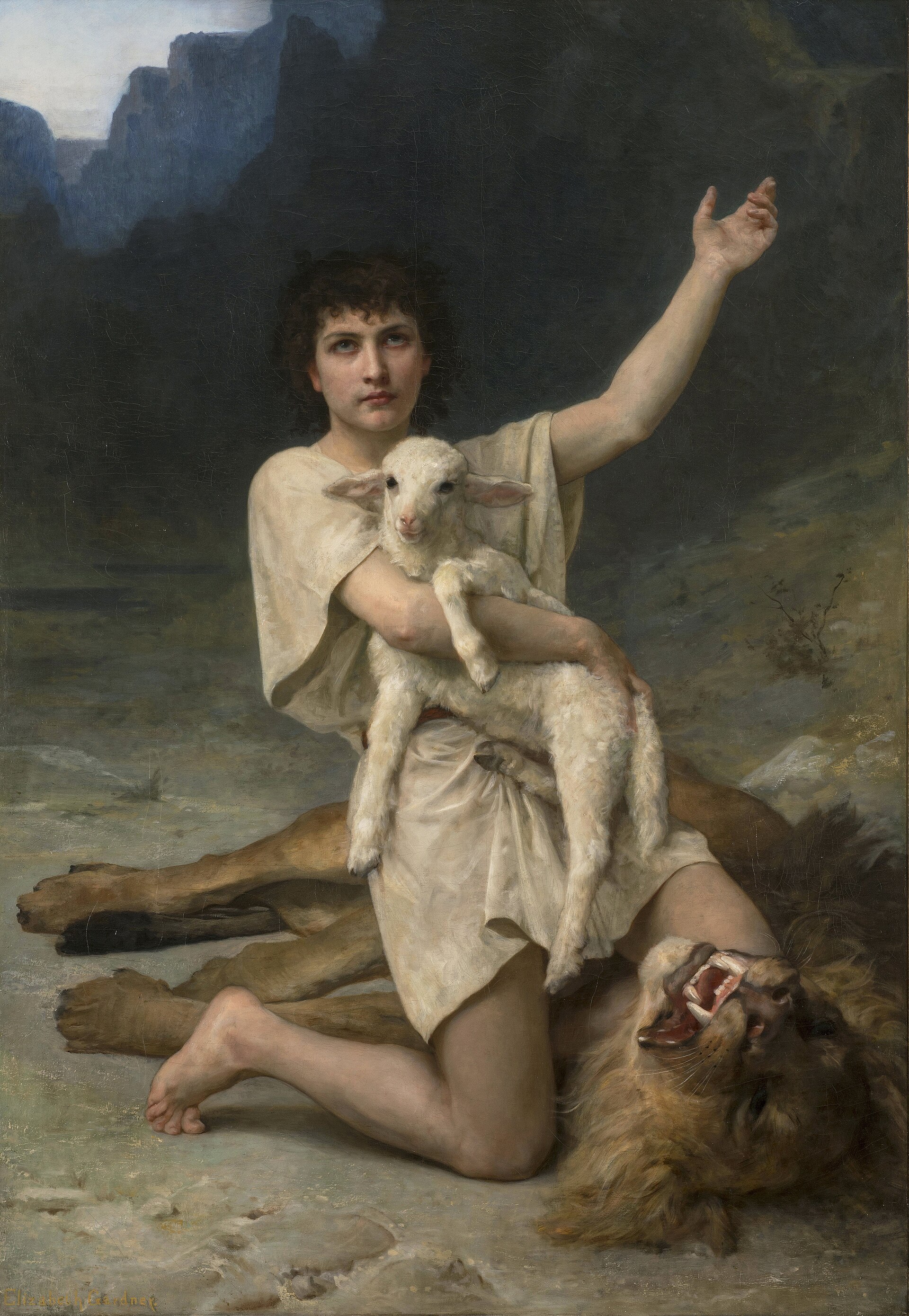
- Era
- Roughly the late 11th century BC, in the last years of Saul's reign
- Place
- The hill country around Bethlehem in Judah, the town of Jesse
- Key passages
- 1 Samuel 16 to 17, Psalm 23, 2 Samuel 7:8, Psalm 78:70-72, John 10
- Tools of the trade
- A staff, a sling, and a shepherd's bag (1 Samuel 17:40)
By Daniel Reeves · Editor, The Bible Well
Published
If you have ever felt overlooked, left out in the field while everyone else was called into the room, David's shepherd years are for you. Before he was a king, before Goliath, before the psalms we still pray, David was a boy with a flock on the hills outside Bethlehem. Nobody in his family thought to send for him when the prophet came. But God did. This page stays in that pasture. It is about David the shepherd, what the Bible says he did there, how God used those quiet years to shape a king, and why the shepherd image runs all the way from Bethlehem to Jesus. If you want David's whole life, from the sheepfold to the throne to his last words, read our full story of King David in the Bible. Here we linger where his story began, in the field, with the sheep.
The story of David the shepherd
The story opens with a grieving prophet and a rejected king. Saul has disobeyed God, and the Lord sends Samuel to Bethlehem, to the house of a man named Jesse, to anoint the next king of Israel (1 Samuel 16:1). Jesse's sons are lined up one by one. The oldest, Eliab, looks every inch a king, and Samuel is sure. But God stops him with words that have comforted every overlooked person since. "The Lord does not look at the things people look at. People look at the outward appearance, but the Lord looks at the heart" (1 Samuel 16:7).
Seven sons pass by. Seven times the answer is no. Then Samuel asks the question no one else had thought to ask. "Are these all the sons you have?" And Jesse answers almost as an afterthought. "There is still the youngest. He is tending the sheep" (1 Samuel 16:11).
Sit with that for a moment. The most important day in the life of Jesse's family, and David is not even invited. He is out on the hillside doing the work nobody else wanted. Samuel refuses to sit down until the boy is brought in. When he walks through the door, straight from the field, the Lord says, "Rise and anoint him; this is the one" (1 Samuel 16:12). Samuel pours the oil, and "from that day on the Spirit of the Lord came powerfully upon David" (1 Samuel 16:13).
And then, remarkably, David goes back to the sheep.
The anointing did not move him into a palace. When King Saul, troubled in spirit, needs a musician, his servants remember a son of Jesse who plays the lyre. Saul sends word to Jesse, "Send me your son David, who is with the sheep" (1 Samuel 16:19). Even then, the Bible says David "went back and forth from Saul to tend his father's sheep at Bethlehem" (1 Samuel 17:15). The future king was still a shepherd, walking between a troubled throne and a quiet field.
It was on one of those ordinary errands that the pasture met the battlefield. Jesse sends David with food for his older brothers, who are with Saul's army facing the Philistines. The Bible notes a small, faithful detail. "Early in the morning David left the flock in the care of a shepherd" (1 Samuel 17:20). He did not abandon them. Even with a battle waiting, he made sure the sheep were kept.
When David arrives and hears the giant Goliath mocking the armies of the living God, his oldest brother turns on him. "And with whom did you leave those few sheep in the wilderness?" (1 Samuel 17:28). You can hear the contempt. Those few sheep. To Eliab, the flock was proof that David did not matter. To God, the flock was where David had been learning everything that mattered.
David tells Saul what those years had taught him. "Your servant has been keeping his father's sheep. When a lion or a bear came and carried off a sheep from the flock, I went after it, struck it and rescued the sheep from its mouth. When it turned on me, I seized it by its hair, struck it and killed it" (1 Samuel 17:34 to 35). And then the line that turns the whole story. "The Lord who rescued me from the paw of the lion and the paw of the bear will rescue me from the hand of this Philistine" (1 Samuel 17:37).
So David walks into the valley as what he is. "Then he took his staff in his hand, chose five smooth stones from the stream, put them in the pouch of his shepherd's bag and, with his sling in his hand, approached the Philistine" (1 Samuel 17:40). No armor. No sword. Just the tools of a shepherd and the God who had been with him in the field. What happens next in the Valley of Elah is told in full on our David page. What matters here is that the giant fell to a shepherd, carrying a shepherd's bag, trusting a shepherd's God.
Timeline of David's shepherd years
- Keeping his father's flock as the youngest of Jesse's eight sons in Bethlehem (1 Samuel 16:11, 1 Samuel 17:12 to 14).
- Anointed by Samuel in front of his brothers after being called in from the sheep (1 Samuel 16:12 to 13).
- Called to Saul's court as a musician, described as the son "who is with the sheep" (1 Samuel 16:18 to 23).
- Going back and forth between Saul's service and his father's flock (1 Samuel 17:15).
- Leaves the flock with a keeper to carry food to his brothers at the front (1 Samuel 17:17 to 20).
- Testifies about the lion and the bear before King Saul (1 Samuel 17:34 to 37).
- Faces Goliath with his staff, his sling, and five stones in his shepherd's bag (1 Samuel 17:40).
- Remembered as the shepherd king when the tribes of Israel recall God's word to him, "You will shepherd my people Israel" (2 Samuel 5:2).
- Reminded by God of where it all began, "I took you from the pasture" (2 Samuel 7:8).
What a shepherd's life was like in Bethlehem
It is easy to picture David's shepherd years as a painting, a boy with a harp on a sunny hill. The Bible does not let us keep that picture for long. The hills around Bethlehem were rough, rocky country. Grass and water had to be found and led to. Sheep wandered, got hurt, and could not defend themselves.
David himself names the danger. Lions and bears were real in that land, and when they came, the shepherd was the only thing standing between the flock and death. David did not stand back and count his losses. He "went after it" (1 Samuel 17:35). He chased the predator down and pulled the lamb from its mouth. That is not a pastime. That is a young man putting his body between the sheep and the thing that wanted to devour them.
The tools tell the same story. The staff was for guiding, for leaning on, for drawing a stray back. The sling was for defense, a weapon a patient shepherd practiced with for hours until the stone went where he meant it to go. The shepherd's bag carried what he needed for long days out in the open. When David walked out to meet Goliath, he took all three (1 Samuel 17:40). The battlefield did not require a new David. It required the one God had been shaping in the field all along.
W. Phillip Keller, who spent years as a sheep rancher himself, wrote A Shepherd Looks at Psalm 23 to help readers see this world from the inside. His point is simple and it lands. Sheep do not take care of themselves. Everything in their life depends on the kind of shepherd they have.
David the shepherd and Psalm 23
This is why Psalm 23 carries such weight. It is titled "A psalm of David," and it is written by a man who knew exactly what a good shepherd does, because he had been one. But notice the turn. In the psalm, David is not the shepherd. He is the sheep.
The Lord is my shepherd, I lack nothing. He makes me lie down in green pastures, he leads me beside quiet waters, he refreshes my soul. He guides me along the right paths for his name's sake. Even though I walk through the darkest valley, I will fear no evil, for you are with me; your rod and your staff, they comfort me.
— Psalm 23:1-4
The Hebrew word for shepherd here, ro'eh, comes from a verb that means to pasture or to tend. It is a feeding, caring, hands-on word. Every line of the psalm is something David had done for his own flock. He had found them grass. He had led them to water. He had guided them on safe paths. He had walked them through dark valleys with a rod and a staff in his hands.
And now, with all his skill, he confesses that he needs a Shepherd too. The boy who once fought the lion is saying, I cannot keep myself. The Lord keeps me.
If you are in a dark valley tonight, this is the psalm David left for you. It does not promise there will be no valley. It promises you will not walk through it alone. "For you are with me." And it ends with a hope that reaches past every valley. "Surely your goodness and love will follow me all the days of my life, and I will dwell in the house of the Lord forever" (Psalm 23:6). Tim and Kathy Keller return to this psalm in The Songs of Jesus, their year of daily devotions in the Psalms, and it is a gentle place to keep praying it.
From shepherding sheep to shepherding Israel
God did not take the shepherd out of David when He made him king. He made the king a shepherd. When the tribes of Israel came to crown him at Hebron, they reminded him that "the Lord said to you, 'You will shepherd my people Israel, and you will become their ruler'" (2 Samuel 5:2). Shepherd came first. Ruler came second.
When David later wanted to build God a house, the Lord answered by reminding him of the pasture. "I took you from the pasture, from tending the flock, and appointed you ruler over my people Israel" (2 Samuel 7:8). It was not a put-down. It was a reminder of grace. You did not climb here. I carried you here.
Generations later, Psalm 78 looks back on David's reign and says it in a single breath.
He chose David his servant and took him from the sheep pens; from tending the sheep he brought him to be the shepherd of his people Jacob, of Israel his inheritance. And David shepherded them with integrity of heart; with skillful hands he led them.
— Psalm 78:70-72
Integrity of heart and skillful hands. The field had taught him both. And when David failed as king, it was the shepherd's heart that surfaced again. Late in his life, when a plague fell on Israel because of his own sin, David cried out to God, "I have sinned; I, the shepherd, have done wrong. These are but sheep. What have they done? Let your hand fall on me and my family" (2 Samuel 24:17). The old shepherd was still willing to stand between the danger and the flock.
Lessons from David's shepherd years
- God sees you in the field. No one thought to call David in. God had already chosen him. If you feel forgotten or passed over, remember that "the Lord looks at the heart" (1 Samuel 16:7). Being unseen by people is not the same as being unseen by God.
- Faithfulness in small things is not small. Eliab called them "those few sheep" (1 Samuel 17:28). God called that same work the training ground of a king. The ordinary, unnoticed thing in front of you today may be where God is shaping you most.
- Yesterday's rescue is fuel for today's courage. David did not face Goliath by feeling brave. He faced him by remembering. "The Lord who rescued me from the paw of the lion and the paw of the bear will rescue me" (1 Samuel 17:37). Look back at where God has already carried you. That memory is not nostalgia. It is strength.
- Even shepherds need a Shepherd. The most skilled keeper of sheep in Israel wrote, "The Lord is my shepherd" (Psalm 23:1). Leading others does not mean you stop needing to be led.
- Real leadership looks like care. God did not call David to rule Israel like a master over servants but to shepherd them "with integrity of heart" (Psalm 78:72). Whoever you are responsible for, a family, a class, a team, a church, the pattern is the same. Know them. Feed them. Guard them.
Key Bible verses about David the shepherd
So he asked Jesse, "Are these all the sons you have?" "There is still the youngest," Jesse answered. "He is tending the sheep." Samuel said, "Send for him; we will not sit down until he arrives."
— 1 Samuel 16:11
Then Saul sent messengers to Jesse and said, "Send me your son David, who is with the sheep."
— 1 Samuel 16:19
But David said to Saul, "Your servant has been keeping his father's sheep. When a lion or a bear came and carried off a sheep from the flock, I went after it, struck it and rescued the sheep from its mouth. When it turned on me, I seized it by its hair, struck it and killed it."
— 1 Samuel 17:34-35
The Lord who rescued me from the paw of the lion and the paw of the bear will rescue me from the hand of this Philistine.
— 1 Samuel 17:37
Now then, tell my servant David, 'This is what the Lord Almighty says: I took you from the pasture, from tending the flock, and appointed you ruler over my people Israel.
— 2 Samuel 7:8
I will place over them one shepherd, my servant David, and he will tend them; he will tend them and be their shepherd.
— Ezekiel 34:23
How David the shepherd points to Jesus
Long after David died, God made a promise through the prophet Ezekiel that should stop us in our tracks. "I will place over them one shepherd, my servant David, and he will tend them" (Ezekiel 34:23). David was long gone. So who was God talking about? A greater Son of David, a shepherd still to come.
Micah said this Shepherd would come from David's own town (Micah 5:2). When the wise men asked where the Messiah would be born, the answer was Bethlehem, "for out of you will come a ruler who will shepherd my people Israel" (Matthew 2:6). And on the night Jesus was born in the town of David, the first people told the news were "shepherds living out in the fields nearby, keeping watch over their flocks at night" (Luke 2:8). The same hills. Perhaps the same kind of flocks. The Shepherd had come home.
Then Jesus said it Himself.
I am the good shepherd. The good shepherd lays down his life for the sheep.
— John 10:11
Here is where David's story bends toward something greater than David. David risked his life for his sheep and lived to tell Saul about it. Jesus did not just risk His life. He laid it down. David pulled a lamb out of a lion's mouth. Jesus went into death itself to bring His sheep out, and rose again. That is why Scripture calls Him "that great Shepherd of the sheep" (Hebrews 13:20) and "the Chief Shepherd" (1 Peter 5:4).
And He does not only save the flock. He knows it. "I am the good shepherd; I know my sheep and my sheep know me" (John 10:14). The Shepherd David sang about in Psalm 23 has a name and a face, and He knows yours. "My sheep listen to my voice; I know them, and they follow me. I give them eternal life, and they shall never perish; no one will snatch them out of my hand" (John 10:27 to 28).
If you have wandered, this is the Shepherd who goes after the one that is lost until He finds it, as Jesus told in the parable of the lost sheep (Luke 15:4). The story that began with a boy in a Bethlehem field ends with the Lamb Himself as Shepherd. "For the Lamb at the center of the throne will be their shepherd; 'he will lead them to springs of living water.' 'And God will wipe away every tear from their eyes'" (Revelation 7:17).
Further study
For the rest of David's life, from Goliath to the throne to Psalm 51, read the story of David in the Bible. If you want to see another leader God shaped in the sheep fields, Moses spent forty years "tending the flock of Jethro his father-in-law" (Exodus 3:1) before the burning bush.
To sit longer with Jesus the Good Shepherd, our Gospel of John study guide walks through John 10 with questions you can use alone or in a group. And if you are in a dark valley right now, the verses gathered in Bible verses about hope are a good companion to Psalm 23.
For reading beyond this site, W. Phillip Keller's A Shepherd Looks at Psalm 23 is a short, warm book written by a man who kept sheep for years. Eugene Peterson's Leap Over a Wall is a pastor's reflection on David's life and what it teaches about following God in ordinary days.
Related questions
+Was David a shepherd?
Yes. The Bible says so plainly and more than once. When Samuel came to anoint a new king, Jesse said of his youngest son, "He is tending the sheep" (1 Samuel 16:11). David told Saul, "Your servant has been keeping his father's sheep" (1 Samuel 17:34). Years later God reminded him, "I took you from the pasture, from tending the flock, and appointed you ruler over my people Israel" (2 Samuel 7:8).
+Why was David tending the sheep when Samuel came?
David was the youngest of Jesse's eight sons (1 Samuel 17:12 to 14), and the flock was his to keep. When Samuel asked for Jesse's sons, no one thought to call him in from the fields. Jesse had seven sons pass before the prophet first (1 Samuel 16:10). The one God had chosen was the one nobody thought to count.
+Did David keep shepherding after he was anointed?
For a while, yes. Even after he began playing the lyre for King Saul, 1 Samuel 17:15 says David "went back and forth from Saul to tend his father's sheep at Bethlehem." On the morning he went to the battle line where Goliath stood, he first "left the flock in the care of a shepherd" (1 Samuel 17:20). The anointing did not end the ordinary work right away.
+Did David write Psalm 23 while he was a shepherd?
The psalm is titled "A psalm of David," but the Bible does not say when he wrote it. It may come from his youth, his years on the run, or his later life as king. What is clear is that it is written by someone who knew sheep from the inside. The man who once led a flock to water is now the sheep, and the Lord is the one leading him.
+How is David the shepherd different from Jesus the Good Shepherd?
David risked his life for his sheep. Jesus gave His. "The good shepherd lays down his life for the sheep" (John 10:11). David fought off a lion and a bear with his hands. Jesus went into death itself and came back, which is why Hebrews 13:20 calls Him "that great Shepherd of the sheep." David was a shepherd king. Jesus is the Shepherd that David himself was following.